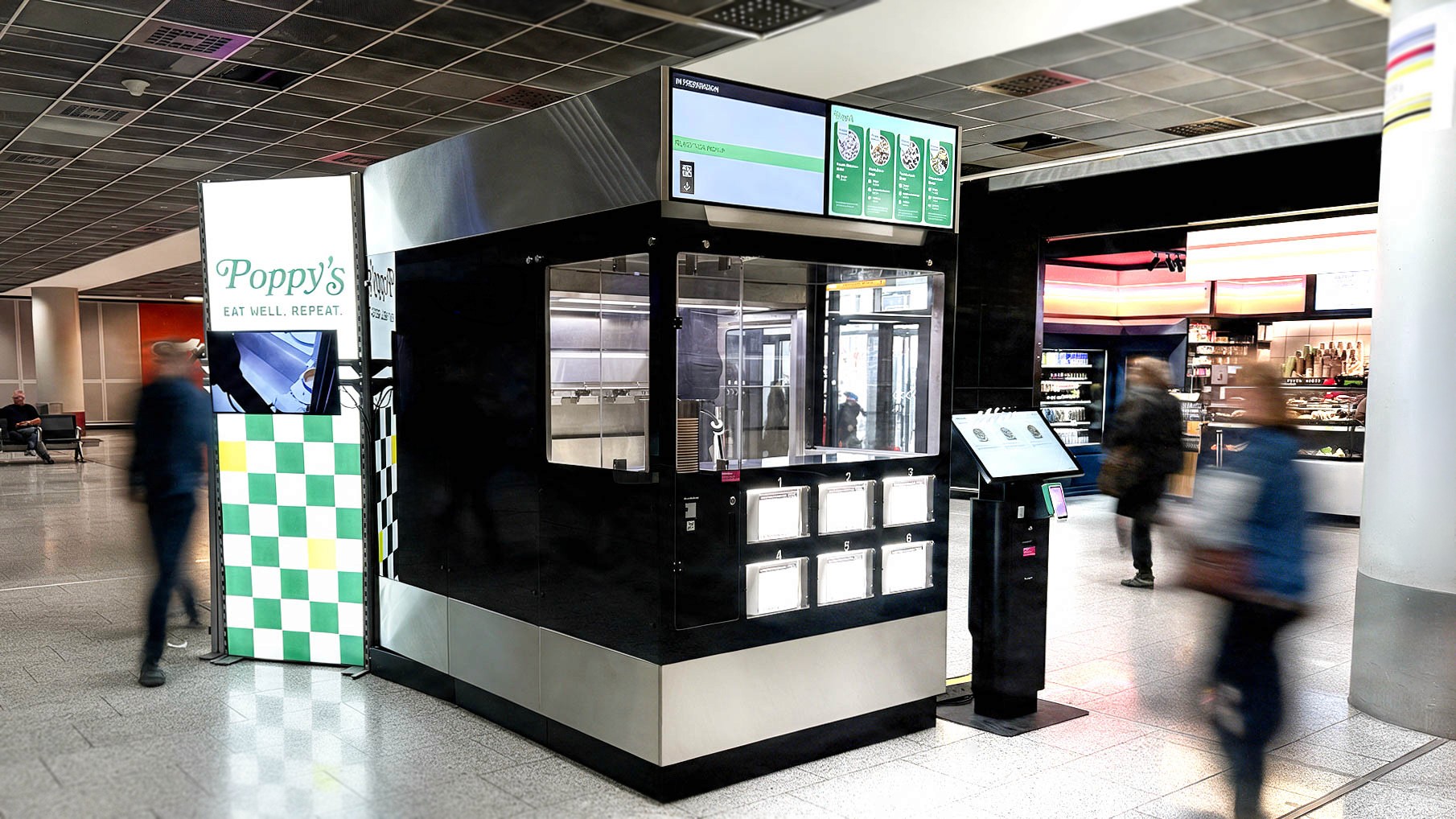
goodBytz presents new product: emma.
goodBytz introduces emma.: 40% more compact and further developed for everyday operations
Press

goodBytz introduces emma.: 40% more compact and further developed for everyday operations
Hamburg, September 9, 2026 – Hamburg-based food tech company goodBytz is expanding its product portfolio with emma., the next generation of its autonomous kitchen robotics. The new system builds on insights gained from operating existing goodBytz systems in real-world environments and was developed with a clear objective: to make autonomous food preparation more compact, easier to integrate and more efficient in day-to-day operations.
emma. fully autonomously prepares 80 to 120 fresh meals per hour while requiring 40% less space than previous systems with a comparable range of functions. Its significantly reduced footprint and single-side access make the kitchen robot easier to integrate into existing spaces and food service concepts.
“With every system we deploy, we learn. We see how our customers use the robots, what requirements emerge in daily operations and where we can improve further. These insights have directly shaped the development of emma.,” says Dr. Hendrik Susemihl, Co-Founder and CEO of goodBytz.
From real-world experience to the next product generation
Since deploying its first commercial systems, goodBytz has continuously developed its technology under real-world operating conditions. These experiences have shown that, in addition to autonomous food preparation, factors such as space requirements, integration, cleaning, maintenance and ease of use are crucial to the economically viable deployment of kitchen robotics.
These insights formed the foundation for emma. Its reduced footprint opens up opportunities for locations where previous systems were difficult to integrate due to space constraints. At the same time, the system architecture has been consistently designed to simplify day-to-day operations.
More automation from preparation to the finished dish
With emma., goodBytz automates additional steps around food preparation and serving. For the first time, automated topping and bowl assembly are integrated directly into the system, requiring less space and enabling implementation at lower cost. Depending on the dish, fresh herbs, seeds, cheese, sauces and other ingredients can be added automatically.
Two integrated bowl dispensers provide the required bowls for both single-use and reusable options in parallel. An integrated pick-up screen supports the handover process and guides guests through collection. Six locker boxes then enable guests to collect their finished dishes directly.
This allows emma. to extend automation beyond the cooking process itself while creating more possibilities for significantly more complex dishes featuring multiple layers as well as both hot and cold components. The final presentation of dishes can also be automated to a greater extent.
Simplified day-to-day operations
Operation, cleaning, service and maintenance have also been fundamentally improved with emma. Single-side access provides easier access to the system and its key components. The integrated cleaning system is also more accessible.
Cleaning has been simplified and requires less time. At the same time, the system has been designed to reduce errors during daily operations. For example, the design prevents pots from being inserted incorrectly into the system.
On-site installation has also been simplified, reducing the required setup time by several hours. The goal of these improvements is not only to automate cooking itself, but also to make all processes surrounding the operation of the system as simple as possible.
Customizable for different concepts
One of emma.’s most visible new features is its customizable exterior cladding. Colors, materials and design can be adapted to different brands, locations and environments.
This allows emma. to integrate not only technically but also visually into existing food service, retail and catering concepts. Particularly in locations where the kitchen robot is visible to guests, the system can become part of the overall brand and dining experience.
Proven technology as the foundation
emma.’s technological foundation builds on goodBytz systems already operating in the market. This includes the autonomous preparation of dishes from raw ingredients. The systems perform the actual cooking process rather than simply heating or assembling pre-prepared components.
Using Smart AI Scheduling, the software optimizes cooking processes based on incoming orders. The system coordinates individual preparation steps and dynamically adjusts workflows according to the current order situation.
Ingredients and components can also be replenished while the system is running. Thanks to the hot-swap principle, required components can be refilled without interrupting the overall production process.
“We have demonstrated that autonomous cooking works in real-world operations. With emma., our focus now is on making this technology accessible to more locations and use cases,” says Susemihl.
About goodBytz
goodBytz is a Hamburg-based food tech company developing autonomous kitchen robots for professional food service and catering operations. Its systems combine robotics, software and kitchen technology to automate key steps in the preparation of fresh meals. The solutions are used across a range of environments, including corporate cafeterias, food retail and travel, as well as universities, hospitals and the defense sector.
The company was founded in 2021 by Dr. Hendrik Susemihl, Kevin Deutmarg and Philipp von Stürmer. goodBytz has had its first commercial kitchen robots in operation since 2024.
goodBytz introduces emma.: 40 percent more compact and designed for everyday operations
Hamburg, September 9, 2026 – Hamburg-based food tech company goodBytz is expanding its product portfolio with emma., the next generation of its autonomous kitchen robotics. The new system builds on insights gained from operating existing goodBytz systems in real-world environments and was developed with one clear goal: to make autonomous food preparation more compact, easier to integrate and more efficient in everyday operations.
emma. autonomously prepares 80 to 120 fresh meals per hour while requiring 40 percent less space than previous systems with a comparable range of functions. Its significantly reduced footprint and Single Side Access make the kitchen robot easier to integrate into existing spaces and foodservice concepts.
“With every system in the field, we learn. We see how our customers use our robots, what challenges arise in everyday operations and where we can improve. These insights have directly shaped the development of emma.,” says Dr. Hendrik Susemihl, Co-Founder and CEO of goodBytz.
From real-world experience to the next product generation
Since deploying its first commercial systems, goodBytz has continuously developed its technology under real-world operating conditions. These deployments have shown that beyond autonomous food preparation, factors such as footprint, integration, cleaning, maintenance and ease of use are critical to making kitchen robotics economically viable at scale.
These insights formed the foundation for emma. Its smaller footprint opens up new possibilities for locations where previous systems were difficult to integrate due to space limitations. At the same time, the system architecture has been designed specifically to simplify everyday operations. With Single Side Access, all areas relevant to daily operation can be accessed from one side, allowing the system to fit more flexibly into existing spaces.
More automation from cooking to the finished dish
With emma., goodBytz automates additional steps around food preparation, assembly and pick-up. For the first time, the automated addition of different ingredients and components, as well as Bowl Assembly, are integrated directly into the system. This means emma. not only handles the cooking process itself but can also automatically add further components and assemble the finished dish.
This goes far beyond traditional toppings. Depending on the dish, sauces, proteins, salads, cold side dishes, cheese, seeds, herbs, crunchy components or fruit can all be added automatically. A bowl, for example, can be completed with salad, protein or a cold rice component, while porridge can be finished with fruit, granola and other ingredients.
Two integrated Bowl Dispensers provide the required bowls for both single-use and reusable concepts. An integrated Pick-up Screen supports the handover process and guides guests through meal collection. Six Locker Boxes then enable guests to collect their finished dishes directly.
By combining freshly cooked food with additional ingredients and components, emma. extends automation significantly beyond the cooking process itself. This enables more complex dishes with different ingredients, textures and layers to be assembled automatically and served ready for collection.
Designed for easier everyday operations
Operation, cleaning, service and maintenance have also been further developed with emma. Single Side Access provides easier access to the system and its relevant components, while the integrated cleaning system is also more accessible.
The cleaning process has been simplified and requires less time. At the same time, the system has been designed to reduce errors during daily operation. Pots, for example, can no longer be inserted incorrectly due to their new design.
Components can also be replenished while the system is running. Through the Hot-Swap principle, required components can be refilled without interrupting the entire production process.
On-site installation has also been simplified, reducing the time required to set up the system by several hours. The goal of these developments is to make not only autonomous cooking itself, but all processes surrounding the operation of the system as simple and efficient as possible.
Customizable for different concepts
One of emma.’s most visible new features is its customizable exterior cladding. Colors, materials and design can be adapted to different brands, locations and environments.
This allows emma. to integrate not only technically but also visually into existing foodservice, retail and catering concepts. Particularly in locations where the kitchen robot is visible to guests, the system can become part of the overall brand and dining experience.
Proven technology at its core
emma. builds on the technological foundation of goodBytz systems already operating in the market. This includes the autonomous preparation of dishes from raw ingredients. The systems perform the actual cooking process rather than simply heating or assembling pre-prepared components.
Through Smart AI Scheduling, the software optimizes cooking processes based on incoming orders. The system coordinates individual preparation steps and dynamically adjusts workflows to the current order situation.
“We have proven that autonomous cooking works in real-world operations. With emma., our focus is now on making this technology accessible to more locations and more use cases,” says Susemihl.
About goodBytz
goodBytz is a Hamburg-based food tech company developing autonomous kitchen robots for professional foodservice and catering. Its systems combine robotics, software and kitchen technology to automate key steps in the preparation of fresh meals. The solutions are used across corporate catering, grocery retail and travel, as well as at universities, hospitals and in the defense sector.
The company was founded in 2021 by Dr. Hendrik Susemihl, Kevin Deutmarg and Philipp von Stürmer. The first commercial goodBytz kitchen robots have been in operation since 2024.
About goodBytz
goodBytz develops autonomous, modular kitchen systems for professional food service and large-scale catering. The company combines robotics, software, and culinary expertise to make fresh meals available efficiently, reliably, and at scale.

Written by
Lea Ley
Connect on LinkedIn